 OfficeSwap
OfficeSpace vs Envoy vs Skedda: Which Fits a Firm With Private Offices?
If you're comparing OfficeSpace vs Envoy or OfficeSpace vs Skedda, you're probably the person who got handed the office problem: an office manager, an operations director or a managing partner at a firm where people are in part of the week and rooms sit empty the rest.
All three are good products. They were built for different jobs, though, and most comparisons are written for open-plan companies with rows of hot desks. This one is written for firms where people have their own private offices: law firms, accounting practices, wealth managers, dental and medical groups, consultancies. For you, one question matters more than any feature list: can the person who has an office lend it for the days they're away?
Facts about each product below come from their own websites and help pages, checked in October 2026. Products and prices change, so confirm with each vendor before you decide.
The short answer
- Choose OfficeSpace if you need full facilities software: stack plans, move management and asset tracking, with desk booking as one part of it.
- Choose Envoy if visitor sign-in at the front desk is your main need and desk reservations are a nice extra.
- Choose Skedda if you mostly book meeting rooms and hot desks from a floor plan.
- If your offices are assigned and you want the empty ones used without taking them away from anyone, read the section on lending an assigned office before you pick.
What each tool is built for
OfficeSpace
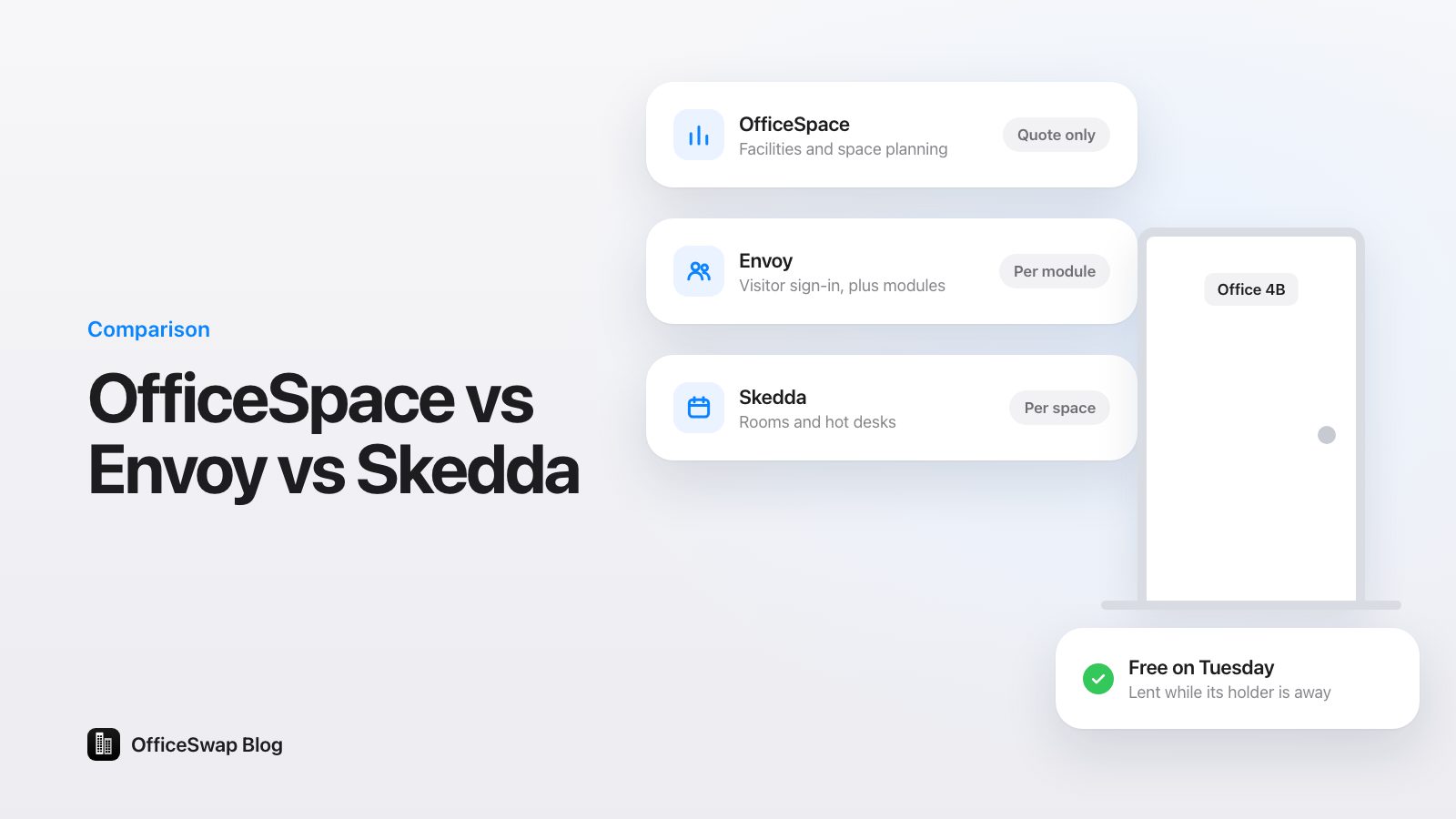
Enterprise facilities software. Its core is space planning: stack plans, moves, assets and occupancy, with desk and room booking alongside. It runs on the web, iOS, Android, Slack, Microsoft Teams and kiosks. Pricing is by quote, with a platform fee per plan, extra charges per employee over a set number and add-ons for some features. No free trial is mentioned on its plans page.
Envoy
Best known for visitor management: the iPad at reception where guests sign in. Desk and room reservations, deliveries, signage and safety are sold as separate modules. Reservations are listed at $5 per bookable resource a month, billed annually, plus a platform fee that isn't published. Visitor sign-in has a free plan; reservations show "Get a quote."
Skedda
Self-serve booking for rooms, hot desks and other spaces from an interactive floor plan. It's priced per bookable space and billed annually, with a 14-day free trial. Assigned spaces come with its higher Premier plan.
OfficeSpace vs Envoy
These two get compared because both sell to the same buyer, usually facilities or workplace teams, but they start from opposite ends of the building.
- Main job. OfficeSpace plans the space: who sits where, moves, floor stacks. Envoy runs the front door: visitors, deliveries, then desks and rooms as add-ons.
- Pricing. Both have parts you can't see without a sales call. OfficeSpace is quote-only with per-employee charges. Envoy publishes a per-resource price for Reservations but not its platform fee.
- Lending an assigned desk. Both have a version of it. OfficeSpace calls it Desk Lending: a desk's owner or an admin schedules dates when it can be booked, depending on the plan. Envoy's desk lending, part of the Reservations module, lets someone make an assigned desk bookable on days they're out.
- Setup effort. OfficeSpace is usually a facilities project with floor plans. Envoy is quicker to start if you're already using it for visitors.
For a firm with private offices: if you don't run a large facilities team and don't need visitor sign-in, you'd be paying for a lot of machinery to solve a fairly simple problem: matching empty offices to the people who need them that day.
OfficeSpace vs Skedda
- Scale. OfficeSpace is built for big real estate portfolios and facilities teams. Skedda is lighter and self-serve: you upload a floor plan and people book.
- Pricing. OfficeSpace is quote-only. Skedda is priced per bookable space, billed annually, and you can try it for 14 days without talking to anyone.
- Assigned spaces. This is the big difference for private offices. OfficeSpace lets a desk's owner or an admin open it for booking on certain dates. In Skedda, an assigned space is marked not bookable. Its help pages describe admins reassigning spaces, with no documented way for the person assigned to release theirs for the days they're away.
For a firm with private offices: Skedda is a good fit for the conference rooms and any shared desks. It won't help much with the partner's office that sits dark every Friday.
And Envoy vs Skedda?
If you're choosing between those two, it comes down to the front desk. If you need visitor sign-in, NDAs and badge printing, Envoy does that well and adds reservations. If you only need room and desk booking, Skedda is simpler and you can price it yourself.
Side by side
| OfficeSpace | Envoy | Skedda | |
|---|---|---|---|
| Built for | Facilities and space planning | Visitor sign-in, plus modules | Room and hot desk booking |
| Published prices | No, quote only | Partly; platform fee not published | Per space, billed annually |
| Free trial | None mentioned | Free visitor plan; reservations by quote | 14 days |
| Lend an assigned space | Desk Lending, depending on plan | Desk lending in Reservations | Assigned spaces are not bookable |
The question that matters: can people lend their own office?
Most booking tools assume a pool of desks that nobody owns. Hot desking is the classic version: first in, first seated. Firms with private offices tend to dislike it for good reasons. People keep files, monitors and family photos in their offices, client calls need a closed door, and senior people won't give up a room they earned.
The model that fits is reverse hoteling. Every office stays with its holder. When they'll be out, in court, at a client site or on leave, they release it for those days, and a colleague who needs a room gets it. Nobody loses an office, and the empty ones get used.
When you look at any tool, ask these about lending specifically:
- Who can release an office? The person who has it, or only an admin?
- Is it on every plan? Or only a higher tier or a paid module?
- What happens when nothing is free? Does the request just fail, or does the person wait in line and get the next office that opens up?
- Who decides who gets it? A fair, visible rule, or whoever refreshes fastest?
- How much setup? Do you need floor plans and a facilities project before anyone can share a room?
We go deeper on these in best office hoteling software: what to look for.
Hot desk alternatives for firms that won't hot desk
A lot of people searching these comparisons are really looking for an alternative to hot desking. If your partners or providers would revolt at losing their offices, you have three realistic options:
- Keep assigned offices and accept the empty ones. The most expensive option. Our empty office cost calculator shows what it costs.
- A rotation or team schedule. Fixed days per team. Simple, but rigid when someone's week changes. See how to plan a hybrid office schedule.
- Reverse hoteling. Offices stay assigned and are lent on away days. Usually the easiest sell to senior people because nobody gives anything up.
The full comparison is in hot desking alternatives for firms with private offices, and hot desking vs office sharing explains the difference in one page.
A note for dental and medical practices
Dental and medical groups land on these comparisons too, often after searching for ways to share office space. It's worth separating two situations:
- One group, several clinics. A provider works Monday at one site and Tuesday at another, a practice manager covers two locations, and private offices sit empty while visitors chart in the break room. That's an office hoteling problem, and lending offices on away days solves it. See office hoteling for medical and dental groups.
- Two separate practices sharing a suite or operatories. That's mainly a lease, sublease and compliance question, so talk to your landlord and advisers first. Booking software, including OfficeSwap, shares offices within one organization. It isn't a marketplace for renting space to another practice.
Where OfficeSwap fits, honestly
OfficeSwap does one thing: it gets the private offices you already have used when their holders are away. Office holders tap Offer My Office and pick the days. Colleagues request the days they're in. Offices are matched automatically, first come, first served, and if nothing is free the person joins a fair waitlist and gets the next office that opens up. Admins see which offices are used and which sit empty, without sensors.
- Pricing is published: from $299 a month, based only on the workspaces you list, with unlimited employees and locations. Billed monthly, no annual contract, and a 30-day free trial with every feature. See pricing explained.
- It runs on iPhone, iPad and any web browser, including Android phones, with a daily summary in Slack or Microsoft Teams. Nothing to install on the walls.
It isn't the right tool for everything. If you need visitor sign-in, use Envoy or something like it. If you're planning moves across a large portfolio, OfficeSpace does that and OfficeSwap doesn't. If you only book meeting rooms, Skedda is a fine choice. Plenty of firms run a room-booking or visitor tool alongside OfficeSwap.
For the detail, see our side-by-side pages: OfficeSwap vs OfficeSpace, OfficeSwap vs Envoy and OfficeSwap vs Skedda.
Common questions
"Is OfficeSwap the same as OfficeSpace?"
No. The names are similar, but they're different companies and different products. OfficeSpace is facilities and space planning software. OfficeSwap is an app for sharing private offices on the days their holders are away. OfficeSwap isn't affiliated with OfficeSpace, Envoy or Skedda.
"What's the difference between office hoteling and reverse hoteling?"
In classic office hoteling, nobody owns a room and everyone books from a shared pool. In reverse hoteling, offices stay assigned and are lent out on the days their holders are away.
"Do we need floor plans to start?"
For OfficeSpace and Skedda, floor plans are central. OfficeSwap only needs a list of your offices and who holds them, and you can paste or scan it in. See setting up a new organization.
"How do we get partners to agree?"
Ask little of them: they keep their office and only lend it on days they're out anyway. Our guide on getting partners to share private offices has a policy you can adapt.
Try it before you decide
You can see how office lending works in about two minutes: open officeswap.co/app and enter the code DEMO. When you're ready, register your organization to start a 30-day free trial.
OfficeSpace, Envoy and Skedda are trademarks of their owners. Facts about them come from their own websites and help pages, checked October 2026.
From the OfficeSwap blog: officeswap.co/blog/officespace-vs-envoy-vs-skedda/