 OfficeSwap
Desk Sharing Ratio: How Many Offices Does a Hybrid Firm Really Need?
Once people are in the office only some days a week, an obvious question follows: how many offices do we actually need? The answer is your desk sharing ratio, the number of people for every workspace. A ratio of 1.4 to 1 means 14 people share 10 offices.
There's no number that suits every firm, and be wary of anyone who offers one. The right ratio depends on how your people really come in. This guide shows how to work it out from your own attendance, how to test it safely, and what to watch for before you give up any space. The numbers below are an illustrative example, not a benchmark.
New to sharing offices? Start with what is office sharing or what is office hoteling.
The ratio in one line
Ratio = people with a workspace ÷ offices you keep.
Forty people sharing 28 offices is a ratio of about 1.4 to 1. Forty people in 40 offices is 1 to 1, which is what most firms with assigned offices have today.
Plan for your busiest day, not the average
The most common mistake is using average attendance. If 30 percent of people are in on an average day, it's tempting to keep 30 percent of the space. But attendance isn't even. Most firms have a few busy days, usually in the middle of the week, and quiet Mondays and Fridays.
On your busiest day every person who comes in needs a room. So the number that matters is peak attendance:
- Count the people who have a workspace. That's your headcount for this purpose.
- Find attendance by weekday. Use a few typical weeks, not one.
- Take the busiest weekday as your peak.
- Add a buffer for visitors, new hires and the weeks that are busier than usual. Ten to twenty percent is a common starting point.
- Offices needed = peak × (1 + buffer).
A worked example
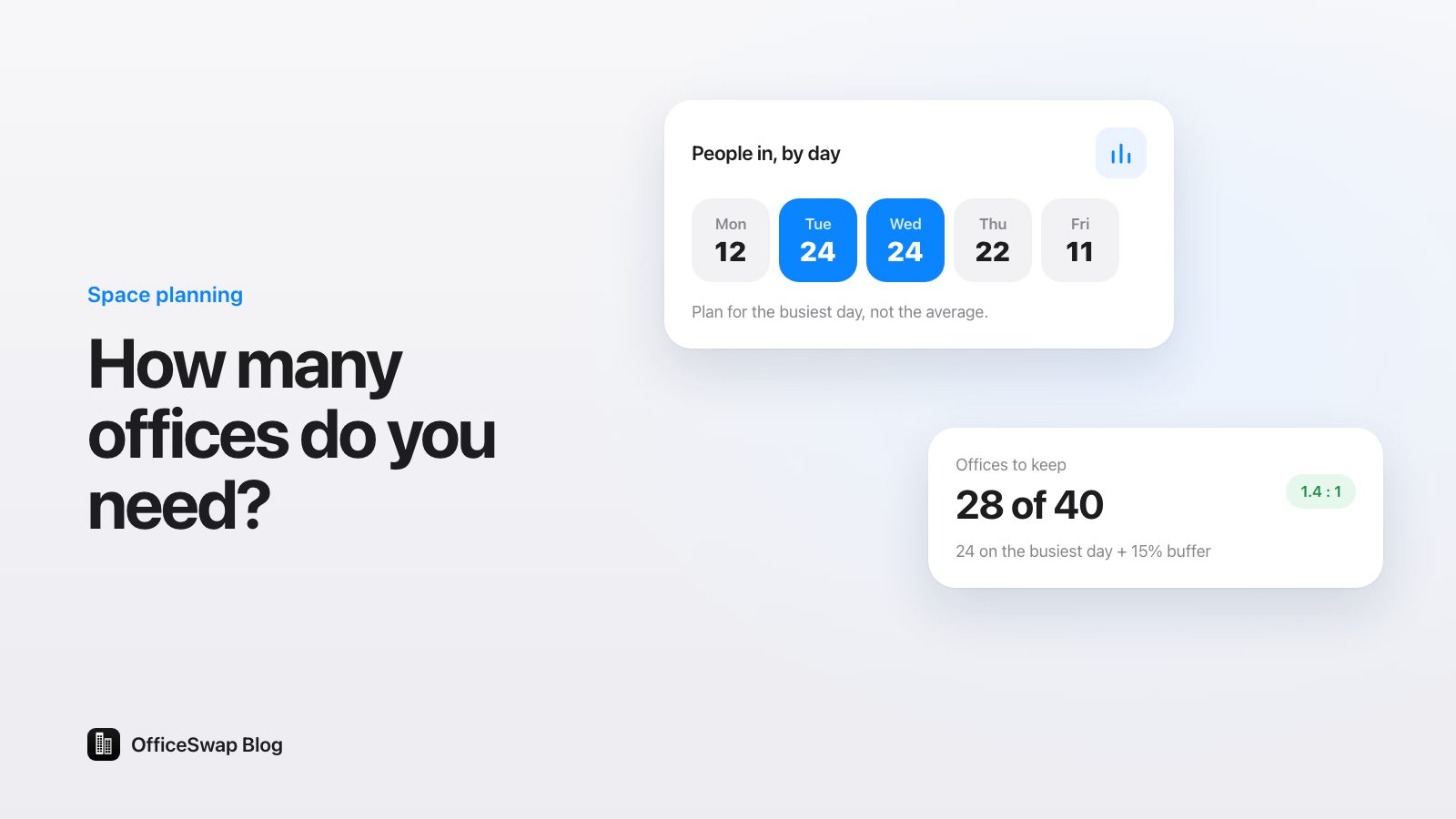
Take a firm with 40 people and 40 private offices. Over a few weeks it sees roughly this attendance (made-up numbers for the example):
| Day | People in |
|---|---|
| Monday | 12 |
| Tuesday | 24 |
| Wednesday | 24 |
| Thursday | 22 |
| Friday | 11 |
The average is about 19 people a day, which would suggest 19 offices. But on Tuesday and Wednesday 24 people need a room. With a 15 percent buffer:
24 × 1.15 = 27.6, so keep 28 offices.
That's a ratio of 40 ÷ 28, about 1.4 to 1. Twelve offices are free to use another way, or to give up at a lease renewal. Using the average would have left the firm short on its two busiest days every week.
Don't cut space first. Share first.
A ratio on paper is a guess. The safe way to find out whether it holds is to share the offices you already have and watch what happens, before you commit to anything permanent.
In a firm with private offices, the practical way to do that is reverse hoteling. Every office stays assigned to its holder. When someone knows they'll be away, they offer their office for those days, and a colleague who needs a room requests one. Nobody loses an office, and you learn how much of the space really sits empty.
With OfficeSwap, a person taps Offer My Office, picks the days and adds an optional note. Someone who needs a room picks the days they're in. The two are matched automatically, first come, first served, and if nothing is free the person joins a waitlist and gets the next office that opens up. See how to offer your office and how the waitlist works.
What the waitlist tells you
The waitlist is the most honest signal you'll get about your ratio:
- Offices go unrequested even on your peak days. You can raise the ratio. There's more space than your people use.
- People wait a day or two and then get a room. The ratio is about right. A little friction is normal.
- The waitlist is long on your peak days and people give up. You've gone too far. Add rooms back, or spread attendance across the week with booking rules.
The numbers come from what people actually offer and request, with no sensors or hardware. OfficeSwap's Insights show how each office is used and which sit empty, with PDF and CSV export. See how to measure office utilization without sensors and office analytics for admins.
Mistakes to avoid
- Using the average. As above, plan for the peak.
- Counting one quiet or one busy week. Use several, and include the busy ones.
- Forgetting seasons. Some firms have a heavy stretch each year. An accounting firm in tax season needs more rooms than the rest of the year. See what accounting firms can do with empty offices after tax season.
- Ignoring meeting rooms and visitors. Colleagues from other branches and new hires need somewhere to sit too. See managing visiting colleagues across multiple offices.
- Deciding right before a lease deadline. Gather the data first. Our lease renewal checklist and guide to reducing lease costs without moving show how to use it.
What the savings could be worth
Once you know how many offices you can spare, multiply by what each one costs you per year. Our empty office cost calculator does the arithmetic, and how to calculate the cost of empty offices walks through a full example.
Common questions
"Is 1.4 to 1 a good ratio?"
It's the ratio in the example above, not a target. Your own busiest day decides it.
"Will people accept sharing?"
People accept it more easily when they keep their own office and lend it only on days they'll be away. That's why the reverse hoteling approach works for firms with private offices. See how to get partners to share private offices.
"What if our attendance changes?"
Then your ratio should too. Because OfficeSwap records real offers and requests, you can check it again each quarter instead of guessing.
How to start
- Pull a few weeks of attendance by weekday, or just ask team leads for their usual in-office days.
- Work out your peak and add a buffer.
- Set up your organization and list your offices. See the setup walkthrough.
- Ask people to offer their offices on away days, and watch the waitlist for a month or two.
- Only then decide whether to change your space. How to roll out OfficeSwap to your team covers the first weeks.
Try it with OfficeSwap
OfficeSwap is an iPhone app, with Android and web access too, for firms that want to share the private offices they already have. Every plan includes unlimited employees and locations, and pricing is based on the workspaces you list. See the plans, or register your organization to start a free trial.
From the OfficeSwap blog: officeswap.co/blog/desk-sharing-ratio-how-many-offices-do-you-need/